How to Write a One-Pager (Structure + Examples)
How to write a one-pager: the five-block structure that fits on one page, writing rules, a real before/after example and a checklist to run before sending.
On this page
A one-pager is a single page that tells one type of reader what you offer, why they should pick you and what to do next. To write one, fill five blocks in this order (what you do → why you → how it works → offer/price → contact) and cut everything that doesn't fit. Below you'll find the structure, the writing rules, a real example made from plain text, and a checklist to run before you hit send.
What a one-pager is (and when to use one)
A one-pager isn't a mini-brochure. A brochure describes your whole business. A one-pager makes one offer to one reader and asks for one next step.
It works best when someone has to decide quickly and you won't be in the room when they do:
- Sales offer. A prospect asked "can you send me something?" after a call. The one-pager is that something, and it's what gets forwarded to whoever signs off on the budget.
- Agency one-pager. A service summary you attach to cold emails or leave after a pitch: what you do, for whom, how an engagement runs, what it costs to start.
- Project brief. An internal page that lines everyone up: the problem, the plan, the timeline, who owns what.
- Partnership proposal. What you bring, what you're asking for, what the partner gets, and who to talk to.
If the page is trying to do two of these jobs at once, you need two one-pagers.
The structure that fits on one page
Nearly every good one-pager follows the same order, because it's the order a reader's questions arrive in.
- What you do. One line, specific enough that a stranger could repeat it. Not "innovative solutions for modern teams" but "fresh lunches for office teams of 10–150, delivered by 12:00."
- Why you. Two or three reasons that a competitor couldn't copy word for word. Concrete facts beat claims: "one invoice per month" is more convincing than "hassle-free billing."
- How it works. Three numbered steps. This is where readers find out how much effort you'll ask of them, so keep it light.
- Offer / price. Plans, packages or a starting price. "From £9 per person" answers the question every reader has; leaving the price off usually just means an extra email before anything happens.
- Contact. One email, one phone number or one link. Put your name or logo at the top of the page so the contact line obviously belongs to someone.
Testimonials, team photos and company history belong in a follow-up; on a one-pager they push out the blocks above.
Writing rules that keep it on one page
- One idea per block. If a block needs a second paragraph, it's two ideas. Keep the stronger one.
- Numbers over adjectives. "Delivered by 12:00" beats "fast." "6 to 20 people" beats "flexible group sizes." "From £45" beats "affordable."
- Write for skimming. Short headings, short lines, numbered steps. Most readers will glance at the headings and the price before they read anything else.
- One clear next step. Not "email us, call us, follow us and book a demo." Pick the one you want and make it the last thing on the page.
- Cut, don't shrink. If it doesn't fit, delete a block. Shrinking the font makes the page harder to read and doesn't solve anything.
How to make a one-pager with AI (from your own text)
The hard part of a one-pager is the writing. Once you have your five blocks, you don't need to fight a template to lay them out.
In Canvora, which works in the browser:
- Write your five blocks as plain text. Label them if you like ("What we do:", "Why us:"). Clear labels make it easier for the AI to keep your structure.
- Paste the text (or a link, or a document), choose the one-pager format and, if you want, a style such as corporate or elegant.
- Read the result against your text. Line by line: name, facts, prices, contact.
- Ask for changes in the chat. "Remove the tagline under the header," "make the prices bigger," "put the phone number first." Each edit costs 3 credits.
A one-pager is a single visual, so it costs 10 credits. The free plan gives you 150 credits with no card, which is enough to make one and iterate on it several times.
A real example: office catering one-pager
This is exactly what we pasted. The business is fictional, but the output is a real, unedited Canvora result using the corporate style.
Before (the input text):
Northside Kitchen — Office Catering, one-pager for local businesses. What we do: fresh lunches for teams of 10–150, delivered by 12:00. Why us: menus change weekly, vegetarian and gluten-free options on every order, one invoice per month. How it works: 1) pick a weekly plan, 2) confirm headcount by 10:00 the day before, 3) we deliver and clear up. Plans: Weekly Lunch (from £9 per person), Meeting Platters (from £45 per platter), Friday Breakfast (from £6 per person). Contact: hello@northsidekitchen.example · 0161 000 0000.
After (the one-pager):
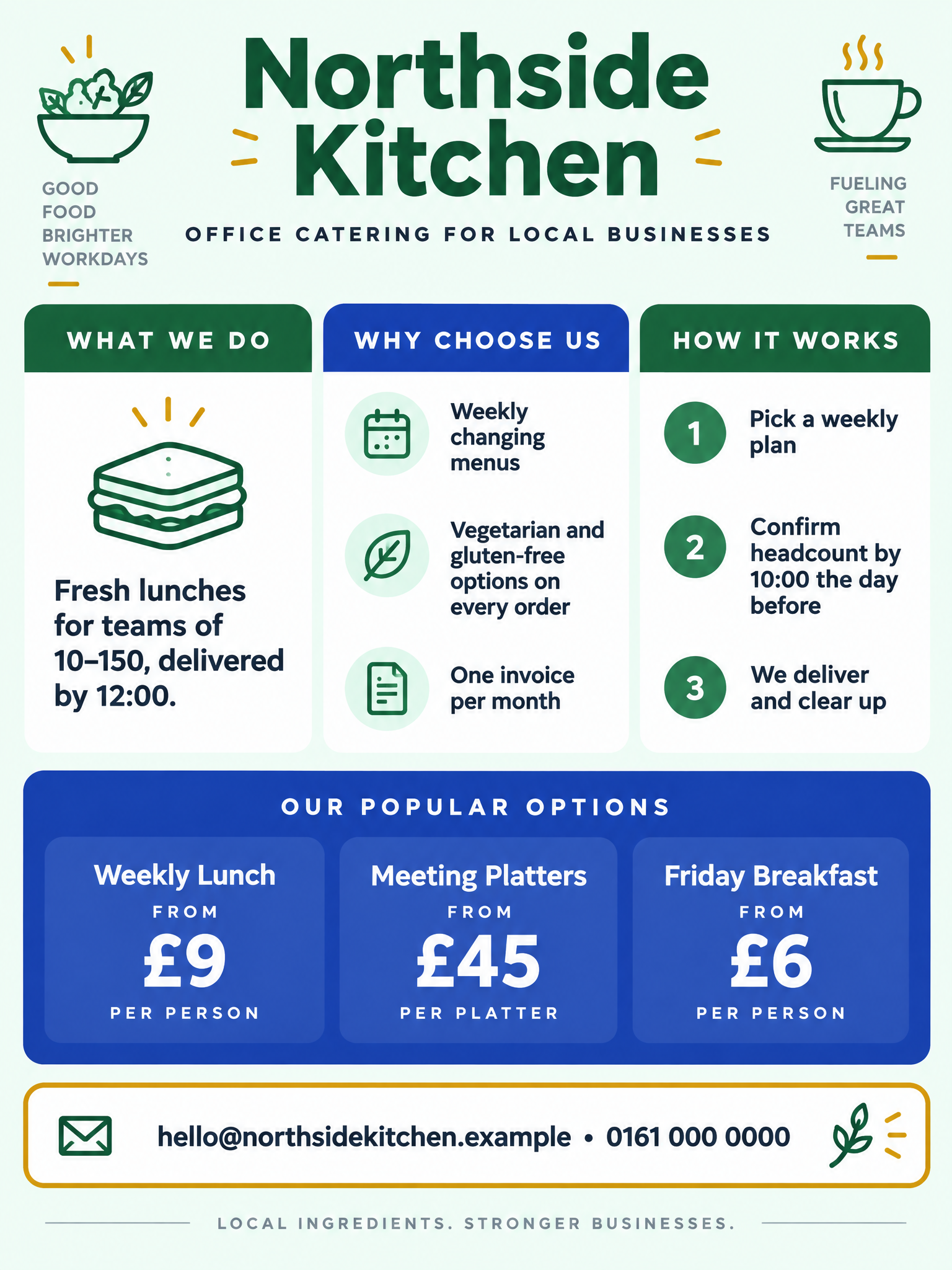
Made in Canvora from the texts shown in this section.
What worked: every fact and every price came through correctly: 10–150 people, 12:00 delivery, the 10:00 cut-off, all three plans with their prices, and both contact details. The page follows exactly the what → why → how → offer → contact order from the input, which is why labelling your blocks helps.
Worth deciding: the design includes a couple of short taglines, "Good food, brighter workdays" and "Local ingredients. Stronger businesses." They fit the tone; decide whether you'd say them to a client yourself. If you'd rather keep only your own words, one chat message removes them.
The same structure in French
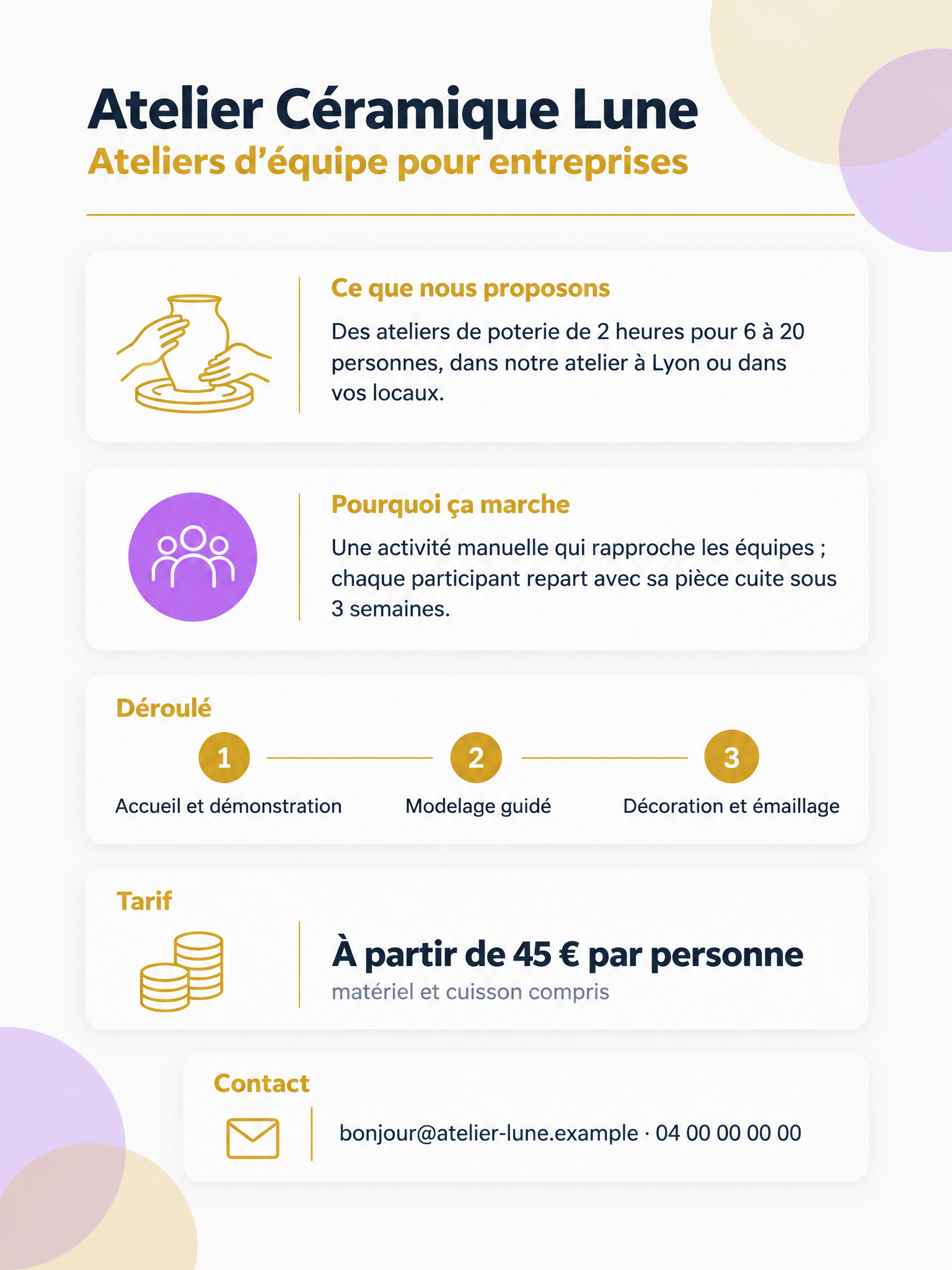
The five-block structure works in any language. Here's a French one-pager for a pottery workshop that runs team-building sessions, made from French input:
The input named every block in French ("Ce que nous proposons", "Pourquoi ça marche", "Déroulé", "Tarif", "Contact") and put the business name and subtitle first, so the page opens with "Atelier Céramique Lune" and follows the same five-block order, with the three steps laid out as a numbered sequence. Whatever the language, write your name and a one-line subtitle at the top of your input: it's the first thing a reader looks for.
Pre-send checklist
Run through this before the page goes anywhere:
- Your business or product name is on the page, near the top.
- The first line says what you do in words a stranger would understand.
- Every number (prices, quantities, times, dates) matches your source.
- There's a price or a clear starting point, not "contact us for pricing."
- The "how it works" part is three steps or fewer.
- There's exactly one next step, and the contact details are spelled correctly.
- Any line you didn't write (taglines, slogans) is one you're happy to stand behind.
- It's readable on a phone screen without zooming.
- Someone who doesn't know your business has read it and can tell you what you sell.
FAQ
What should a one-pager include?
Five blocks, in this order: what you do, why you, how it works, the offer or price, and how to get in touch. Add your name or logo at the top. Anything that doesn't help the reader decide on the next step belongs in a follow-up document, not on the page.
How long should a one-pager be?
One side of one page, readable without zooming. In practice that means a headline, three to five short blocks and a contact line. If you have to shrink the font to make it fit, cut content instead.
What is the difference between a one-pager and a brochure?
A brochure presents your whole business across several pages. A one-pager makes one offer to one kind of reader and asks for one next step. If you sell three different things to three audiences, write three one-pagers.
Can I make a one-pager with AI from my own text?
Yes. In Canvora you paste your text, a link or a document, pick the one-pager format and get a designed page back. Then read it against your source: check that your business name, prices and contact details are on it, and ask for changes in the chat. A one-pager is a single visual (10 credits) and each edit costs 3 credits.
Should a one-pager be a PDF or an image?
Use whatever fits the channel. A PDF is easiest to attach to an email or print; an image works better inside a chat message, a LinkedIn post or a proposal deck. Many people keep both versions of the same page.
Can I make a one-pager in another language?
Yes. Write your input in the language you want, or ask for it in the chat. Canvora designs in 150+ languages natively, so the page is laid out for the language rather than translated after the fact. Have a native speaker read it before sending, as with any document.
Have your five blocks written? Turn them into a one-pager and check the result against the list above.
Create your first visual in under a minute
Paste a blog post, PDF, or idea — Canvora generates finished carousels, infographics, and posts, on brand and in your language.
Free to start · 150 credits, no card · 150+ languages